Showing posts with label lee child. Show all posts

Monday, 15 October 2012

Losing that bestseller appeal

Not the original
Every April through 1999 to 2010, I either found myself in a book store or waiting on an Amazon parcel, eager to get my hands on that year's Lee Child novel. I always bought the hardback because that was the only option. The books were consumed within 48 hours with a review posted to Amazon shortly after. Followed by weeks at least of the verbal 'have you read the latest...' buzz that accompanies the rise of any bestseller.

Save for these annual two day reading indulgences at the hand of Lee Child I'm seldom plugged into just one book at a time. I can barely recall a time these last two decades when I've not been humping two or three books around in some obscenely heavy slung over the shoulder bag. Although I admit half the contributing weight will have been a laptop and associated gadgetry. This weighty state of affairs was endured because there was no alternative, it was the only way to meet my insatiable need for reading and technology.

Reviewing my account history at Amazon I can see I ordered my first Kindle in August 2010. It was the 3rd generation Kindle and the first to be sold in the UK. It arrived in September and my reading perspective forever altered. The revelation was that reading no longer required hefting a stack of books with me during my lengthy daily commute, or keeping tabs on the books so I remembered to take them with me. I simply made sure I had a Kindle device at all times. As that increasingly encompassed my Smartphone, iPad, MacBook and work PC, I was never going to be without the book I wanted to read.

In 2011 it was Autumn that saw the release of Lee Child's latest book and I paid a few pence less than the cost of the hardback for the privilege of downloading it on the Kindle. It was on my device at midnight the day of launch and I was still reading it at 3AM. The review was written and posted the following day. I was more than a little put out the Kindle version was SO expensive - more than twice the price of a normal Lee Child Kindle edition. And through the subsequent year I missed being able to swing around in my chair and see the hardback amid my dedicated Reacher shelf. All of which contributed this year (2012) to me swapping back to the hardback, though this was mostly because it was CHEAPER than the Kindle edition. I deliberated this in my Crafty Bastards post back in June - it seemed Lee Child's publisher's were going out of their way to make me buy the hardback. I decided to see whether their desire for me to do this correlated with my reading needs as a fan and avid reader. 'A Wanted Man' hardback arrived at work and I managed to squeeze it into my narrower and less voluminous bag before heading home. I pulled it out and sat in my study and started reading that night.

The next morning I dropped my MacBook and iPad into my bag, checked the Kindle was in there and had the hardback in my hand before realising just how heavy it was in contrast to the other devices. It now seemed an excess akin to packing a mantel clock to check the time through the day. With barely a thought I left the book on the hallway table to read that night instead, a thought I repeated each morning for the rest of the week, always with a mind I'd catch-up with it that night. It was the weekend before Lee Child's latest Reacher got picked up again, spending the Saturday morning reading in the conservatory, where it stayed through several weeks as chance and the weather didn't bring me back. I looked for the hardback through the house but like many things outside of my main focus its whereabouts remained elusive. I later found it efficiently stacked in a pile of magazines and newspapers and at some point it got transported back to the hallway because I saw it there amid a different stack of letters and magazines. I have so far not finished it, not even picked it up to read since that Saturday morning. It's not that I don't want to read it, I really do, but my reading world is no longer focused around a single book. My perspective is all about a few devices that give me access to my whole library, whenever and wherever I am. My books effectively follow me, not the other way round. I will probably finish the Reacher novel the next time I'm at home for any length of time, which will probably be Christmas.

For me part of the fun of being a fan is reading a book on launch. I don't mind paying a premium to do this but paying twice the price isn't going to happen, not even for a Lee Child. If the publisher continues to do this it means there will be one less fan eagerly awaiting Lee Child's future book launches.


John Potter is the author of Chasing Innocence, a 3x award winning and bestselling Crime ThrillerUK US

Sunday, 12 August 2012

Emotional Content

An emotional baseline?
I've found writing my current book very challenging in almost every aspect, which admittedly was the intention. When I first came up with the idea it was one of those moments where the impossible seemed entirely probable. It has been said I'm  trying to achieve too much, trying to layer in too many themes. Quite accurately, I think. But that for me is part of the challenge. Writing any kind of book is an achievement for sure. I've learned a lot about taking a mind on a reading journey, now I want to push it further. The great thing about being my own publisher is I get to do what the hell I like. Writing TMWWRWs has been an incredible learning experience, similar in some ways to writing Chasing Innocence, because writing in a different perspective feels like learning to write all over again. This time around it feels so much more difficult. CI was, at least in my mind, very much about real people put in extraordinary situations. TMWWRWs is thriller, action laced with paranormal. It attempts to be ketchup (courtesy of Malcolm Gladwell) and it's got a soundtrack (thanks to Mr Gould). The characters at its core are real but born from my favourite comic and fiction heroes, without the costumes. Did I mention I've struggled mightily.

The struggles have been documented here in my monthly WordWatchers posts. These last two months though it has really felt like I've hit my stride, increasingly feeling at ease with the main character and the flow of the story. So much so I really wanted to get my head down during July and start thinking about the close of act two. I decided to impose a minimal daily word count.

I don't usually work to a word count because it's easy to get caught trying to move forward and lose sight of what you’re actually trying to do, which is enthral a wide audience. The word count was set at five hundred daily words, which is achievable enough to get me sat in-front of the keyboard, even with the distractions of summer all around, especially this summer. It has gone well. I hit seven thousand words in ten days. I've started to approach sections of the story I dreamed about way back when I first imagined a character called The Handyman. I'm at the bit where we pull together everything that's happened so far and turn the reader on a swell of emotion towards act three. Except I didn't. Instead I hit a very high and deep mental wall.

Emotions are a difficult thing. TMWWRWs is written in the present tense first person perspective. I keep mulling if this is the right perspective but every time I do I come back thinking it absolutely is. The knock for this type of POV though, is that it's very immediate with the reader right in there with the character's every thought. The problem is that I struggle to define or comprehend my own emotional thoughts, at least to write them down, let alone for a fictional character. While I can hear Marcus' voice in my head and I have a real sense for him as a man and a mostly moral human, I've struggled to calibrate his emotions. I think this is exacerbated by the very personal POV of the story. Despite Marcus being an ex-bodyguard once contracted to the US Government, a very physical and sometimes unnaturally capable human, he is in many respects an everyman. A uniquely skilled human trying to work out the world around him. He doesn't have all the answers, he doesn't have an out there IQ or a batcave or a butler. His journey is about trying to understand why the woman he loves was murdered, about realising the questions and hunting down the answers. Albeit in a action thriller setting with that dash of paranormal. 

My immediate reaction to this emotional problem was somewhat unorthodox - I decided to change perspective completely, not Marcus’ but mine. With a respectable word count already in the bag I mothballed my Windows NetBook and got me an Apple Macbook Air. It was a move long overdue and discussed here. It gave me a chance to order my thoughts without worrying too much about being unproductive. At other times a problem like this might have been resolved by reading a book or listening endlessly to Moby, or both.

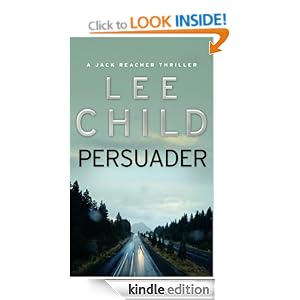
In mulling the problem I looked long and hard about who I think Marcus is. He is not a guy that wears his heart on his sleeve but he is meant to be more human than many men in thriller fiction. Jack Reacher comes to mind as the a-typical one man army and police department and super-computer in a super sized and lethal body. Reacher is rarely driven by any emotion outside of retribution or his own off the scale sense of honour. As a Reacher fan I'm obviously influenced by Lee Child's writing but Marcus isn't Reacher - that would do a dis-service to everything I'm trying to achieve in this series. However, he's a lot closer to Reacher than he is me. So I sat down and started reading the Reacher novels again in the hope I could find Marcus' emotional standpoint. I read Killing Floor and Persuader, which are both written in the first person although not present tense. I'm glad to say I'd got it figured halfway through Persuader.

Armed with this emotional standpoint I decided now was a good time to go back and fill some of the vast, gaping holes at the beginning of the story that I left for the 'edit', as I pitched and rolled onwards with this first draft. Many of these were moments that defined the key characters, but I didn't know what defined them till I got to this stage. If that makes sense?  

These last few weeks have taught me a new set of very valuable writing lessons. Publishing my first book taught me how much of a good story is created in the edit. Writing TMWWRWs largely as an outline so I can get to the edit, has brought to me the realisation just how much of a good story is created during the first draft.

Tuesday, 19 June 2012

Crafty Bastards


It has been a long time since I bought a paperback or hardback book. I'm pretty sure I'm still buying at least as many books as I always have, probably more. As a regular commuter and someone that always has several books on the go, I'm grateful my rucksack isn't close to being as heavy as it was the last two decades. Likewise, holidays don't require checking-in a suitcase containing shorts, flip-flops, t-shirts and 28 kilos of books.

Don't get me wrong. I love the page to page physical interaction with paper books. Equally I don't find reading from a screen detrimental to the reading experience. Typically I'll read on the iPad when I'm indoors or commuting and on my Kindle device if I'm outside or on holiday - simply because the Kindle is smaller and the screen doesn't reflect light. My immersion in digital reading is all about practicalities.

As a writer and publisher of both paperback and digital books I have mixed feelings. There is absolutely nothing like holding a book you have written in your hands. It is a feeling I admit I don't get from holding a Kindle with my book on it. That's not to say it isn't a great feeling. Just nothing like holding the real thing. The trouble is I sell one hundred digital books for every one paperback. Selling digital books and how to price them has been the subject of much conversation in the press and within the publishing industry. Both among commercial and independent publishers like me. The commercial publishing industry seems desperate to retain the pricing paper based books give them, or at least to find some leverage to make money in the digital age.

Anyone that has spent just a little time reading what I write here, will know I hold Lee Child in very high regard. I'm thankfully now over my 'I want to write like Lee Child' phase - I realised I needed to write like me. Lee Child is one of the most successful commercial authors at this time. His next Reacher book - A Wanted Man, is scheduled for release Aug 30 and is currently (June) in the Amazon top #100 book charts. That's not just in fiction, that's across all book genres including non-fiction.

Every year I pre-order the next Reacher book, usually when it appears on Amazon. The last time I bought a Reacher novel anywhere other than Amazon was about 2007. Before I wrote this post I was looking at the Amazon page for A Wanted Man, and like I did in my post on Kindle pricing, I pondered the £10 price-tag for the Kindle edition. It's only £1.50 cheaper than the hardback. The pricing is unusually high even from a commercial publisher with a popular author. While deliberating the high Kindle price I got to thinking how much I used to love looking at my collection of Reacher hardbacks on my bookshelf. About thirty seconds after that I got to thinking I might as well buy the hardback as I'll read it so quickly it's bulk won't be much of an issue. I'll also be able to swing around in my chair and admire the hardback on the shelf, sometimes maybe even pull it out and flick through the pages - as I'm prone to do if I'm searching for inspiration. I'd probably get the Kindle edition anyway for reference and portability when the pricing comes down to paperback levels. Then I got to thinking how clever that was - that I'd pay top dollar for the hardback and then pay again for the convenience of Kindle. Crafty bastards, I thought.

Wednesday, 18 January 2012

Going Kindle for less than the price of a tasty sandwich

I am, it has to be said, a huge fan of ebooks. I bought a Sony e-reader two years ago and owned a Kindle the minute they were released in the UK. I now exclusively read Kindle books because of the convenience. In the main the books are also cheaper. That said, having gone to the trouble of writing and actually printing a book, there is something quite satisfying about holding in your hands tangible evidence for all that toil. Especially when the book looks THIS good. The reality is, while electricity is available to power portable devices, the future role of printed books will gradually evolve away from what it is now. The lesson I learned on this debut publishing experience was a printed book takes a lot of time to produce, and almost as long to filter though wholesalers and distributor databases. In future I'll be making the Kindle version available while the printing mechanics clunk through and not afterwards. Compared to printing a book, publishing for a Kindle was almost a breeze.

I did consider using the free e-book management tool - Calibre. It does a damn fine job of making your book Kindle ready and with a little learning you can get very close to a professional finish.  I didn't consider for one minute uploading the HTML or Word book file directly to Amazon and letting them do everything else, as that would have left the book very much in the hands of automation. I could have hired someone to create the Kindle edition, but it's not that difficult if you've ever done a bit of web design. I did it myself so that I'd have total control over layout. My mantra throughout has been to produce a product at least AS GOOD as those available from 'proper' publishers. To this end my baseline for laying out both book versions was Lee Child's - The Affair.

Both digital and printed versions began with my completed draft of the book. Chasing Innocence was written in OpenOffice and then exported to Word for copy and proof editing. Once that was done it was imported to QuarkExpress for typesetting, for the per page layout of the printed book. Then it was exported to a PDF document format and sent to the printers. For the digital versions, QuarkExpress doesn't have a 'save as Kindle' or 'save as epub' option, so the book was exported as Word. And from Word I exported as 'filtered html' - which removes a lot of the Word specific 'junk code' and leaves you with a relatively un-cluttered html file. HTML is a text file, formatted so you can see content in a web browser. It is also the basis for the content of digital books. The Kindle especially wants uncluttered HTML with little formatting. This is because the Kindle expects to handle much of the text layout or digital typesetting itself, including the font style, the font size and line spacing at the readers choice. I decided on three simple paragraph styles. The first forced the Kindle NOT to indent the first line of each chapter or section. If you take a look at the first paragraph of any chapter of any printed book, you will see why. Without this formatting the Kindle will indent the first line of every paragraph. The second style tells the Kindle what size of indent must be applied to all other paragraphs. No other styling was specified because the Kindle supports very little. If you try to get fancy, what looks pretty in a web browser will probably be ignored or worse, confuse the device. The third was for styling chapter headings. I kept this simple too, trying to reproduce the look of the printed book with centred text and each new chapter starting several centimetres down the page, using the top and bottom margin tags. These three styles made the content of the HTML file nice and easy. I also used the top and bottom margin tags to create ad-hoc spacing in the non-chapter pages at the front and back. Then I manually added in page-breaks at every required section, as letting the Kindle decide had some unexpected results.

The Kindle has a menu option, from which you can select 'GoTo...' From here you can select the beginning, the cover, table of contents and the end.  The device works out the end for itself. For the Table of Contents to work you must name each section in the book using standard HTML 'A' tags. As I had ninety-five chapters and several other distinctive sections, I named the sections and used Calibre to generate the table of contents from a copy. I then pasted that into the beginning of my HTML book file. To make sure the Kindle GoTo menu option works the cover needs to have a name tag of: 'cover', the table of contents: 'TOC and the Title Page: 'Start'. Creating the cover itself was a matter of cropping the book's cover to fit the Kindle screen (600 x 800) and linking the image into the HTML file, and giving it that 'cover' name tag. For the Beginning option you make sure the title page is named 'Start' and you're almost good to go.

Apart from the main HTML body of your book and the cover image file, you need two other files for a fully packaged Kindle book. The first is used by the Kindle to navigate backwards and forwards between chapters in the book. Your bundled book won't be accepted by Amazon without one. Once more I used Calbre to create the 'toc.ncx' and then edited it to my needs.

The next file is almost the final stage. The contents file (OPF) is used to compile your book. I used MobiPocket Creator to do this as it was free and recommended by Amazon, editing the contents it generated to match Amazon guidelines for embedding the cover and pointing to the toc.ncx created previously. I then used it to compile the book. Now this is where it gets interesting. You want to check your book looks good on a Kindle right? While you can download the Kindle previewer for your PC/MAC, it doesn't exactly match how your book will look on a Kindle. If you actually own a Kindle you may know it has its own email address which you can find in its settings pages. If you email your compiled book as an attachment to this address, from the email account you log into Amazon with, it will appear on your Kindle. Usually within five-ten minutes.

By doing this and reviewing on the Kindle, I noticed and changed some formatting, and decided it would look more professional with some logos on the title, copyright and final page. So I added these at the correct locations like I did for the cover and after a few revisions we were good to go. A few days later after the final check-through, I logged into Amazon, specified a separate cover image for the Amazon page, linked it to the printed books ISBN and clicked go. As I own worldwide rights I had to specify a price for each region, instead opting to let the books pricing be based on the US dollar value. This works out at £3:49, which was my initial target price. I will of course monitor and amend the price. Amazon then took the file and processed it, allowing me to download the exact file of Chasing Innocence they will send to your Kindle when you ever so kindly buy it. After I tested it was good, I clicked Finished and after a request to prove I was the author, copyright and world wide rights holder, the book suddenly and quite majestically, appeared on Amazon.

Now all you need to do is click on this link to go to the Kindle version of Chasing Innocence, where you will be one more click from seeing what I've been banging on about these last few months, and importantly, you will be mere seconds from being the proud owner of an enthralling, thriller fiction digital novel that cost you less than a tasty sandwich.

Tuesday, 22 November 2011

The Copy Edit

Somewhere in this world there is a woman named Katie Green. I have never met her but I feel confident right now I could pick her from a crowd, although quite probably she is currently sitting alone in a very dark room. Her hair is likely to be dishevelled and her eyes wide and vacant, her features drawn and a glass of something strong on the table beside her, maybe gin, but more likely whiskey, neat, straight out of the bottle. Katie's hands might shake as she holds the glass and she might even be rhythmically rocking back and forwards in her chair. Maybe murmuring to herself, doubting her career choices, bemoaning the decision to carve a profession in the literary world and wondering how someone could get passed mixed up with past quite so often, is wonder so similar to wander? And is there really quite the need to so seldom punctuate and for so many sentences to have no verb at all!

Yes, that's right. Katie Green just copy edited my book.

I know it was hard work for Katie because I spent thirty two hours over two days this week, going through the raft of changes she has made to the manuscript of Chasing Innocence. There were a lot of changes, but then that is what the copy edit is all about. In the lead-up to publishing a book, someone that has an eye for grammar, the flow of a story and continuity, goes through the whole text and highlights all instances where these are incorrect. When they are done they send it to you (the author) and you then decide which of the changes to accept or reject.

As I have never been through the process I was unreasonably excited to get the script and wasn't quite sure what to expect. To highlight the changes Katie had used Word's change tracking, so all I had to do was start at the beginning and make a decision on whether to accept Katie's first change or reject it, then move onto the next. The book in its A4 double spaced incarnation has five hundred pages and ninety eight chapters. For 75% of the changes accepting is a no brainer, these are punctuation, tense or word choice changes. This also included the need for indents. I had written my whole book without them. I also have a tendency to sometimes place my adjectives at the end of a sentence or miss out a verb. I typically don't use commas as much as I should. Mostly for the same reason I didn't punctuate dialogue properly, because I was busy writing the dialogue. I went back later and added the punctuation, but no matter how hard I tried I would end up reading the text and not punctuating it properly. I even edited the book from back to front at one stage and this helped a little.

I had originally written the beginning of the book without having a very good idea for who would read it. So the narrative was not consistent, this is disconcerting for the reader. I had worked hard fixing this in the edit and even re-written some of the chapters from memory to flatten the narrative. Except the version in my mind was so ingrained the re-written chapters were incredibly similar to the original versions.

On top of this there were unconscious errors. I love the writing style of Lee Child and had at times emulated it without knowing, usually after I had read one of his books. I also had my own idiosyncrasies that I littered the text with. Which meant I would often string too many 'and' into a sentence or start a sentence with Which, which is a big no no apparently.  10% of the issues were caused by me being too wordy, or not being wordy enough. Sometimes towards the end of the book I simply had no more words left to describe anything originally. This resulted in some bumpy scenes. For 5% there were paragraphs or blocks of text that I had struggled over repeatedly, trying to make what I wanted to say work within the context of the story and the requirements of grammar. Usually it meant something had to give. Often in my world that was sentence structure, which made the reader do a double take. 10% of the changes I rejected, simply because the viewpoint of the human editor is sometimes going to conflict with the creative viewpoint of the human writer. It comes down to preference.

The sheer volume of changes were quite bewildering at first. I would turn each page to find another swathed in blue underscore. It was incredibly daunting. I had two days to go through the whole book. After sixteen hours on day one I had only covered thirty three of the ninety eight chapters. Katie green had requested two changes that really threw me - I needed to refer to two characters by different names. I did one but not the other, but getting a sense for each and whether it would work and how that would ripple through the book chewed through a lot of time.

The simple truth is, this was my first book. While I am busy learning a whole bunch of new lessons as I work through book two, the learning curve was incredibly steep for book one. I made a huge number of mistakes in the first third of the book and a decreasing number for the last two thirds. I had fixed many of them during editing but there were a lot of artefacts left over. It took so long to go through the first third of the copy edit because most of the changes were condensed into this area. I got through the final sixty five chapters during day two.

During the course of the two days I went through the whole book checking each proposed change within the context of the sentence, paragraph, page, chapter and book. The two days went so quickly though, that I had conflicting emotions come the end. In one sense I felt like I was suffering from Stockholm Syndrome - Katie had often felt like a tormenting jailor. As I turned each page and came to a favourite section it would inevitably be scored through in blue, a plaintiff wailing 'Nooooo' uttered each time as I scrolled down to see what the proposed change was. At other times I felt an incredible sense of gratitude as time after time after time whole pages were freed from my tongue twisting attempts at wordiness and lack of grammar. The overriding emotion at the end though, was a mixture of elation and a horrible sense of unease.  A full book edit previously had taken me an average of four weeks, this one had flown by in two days. How many new errors would I have introduced? Certainly some. Katie and I are both human, it is inevitable. But would so many changes have completely messed up the whole book?

Before I sent it back I went through the completed edit looking only at grammar and spelling highlighted by Word. I found a total of five errors in the whole book, which were easily fixed. I knew if I held onto the book any longer after that, I might be tempted to start fiddling - I might get to thinking something might not work and try to fix it. Feeling slightly less uneasy I sent it straight back to Lorena at Daniel Goldsmith. I think this is why they give you such a short amount of time to do the copy edit, because if you didn't you would start to doubt the changes. The copy edit is one of the most intrusive parts of the book creation process, it's the first time someone other than you will make such wide ranging changes. You certainly don't want to be making many changes once it is done at all. And what a great decision it proved to be - to send it back straight away.

Four days after sending the book back I packaged the copy edited text onto my Kindle and sat down and started reading. I was heartbroken by the end of chapter three and disonsolete after five chapters. The text and dialogue read all wrong, the pace was out, the sentences read clunkily. I could have cried, what had happened to my book? I read another two chapters and it was the same disjointed and clunky read. It was at this point I was very glad the book had been sent back, because my first instinct was to sit down and fix it. Experience though had told me something else might be causing the problem.

The clunkiness that now existed in my book reminded me of something I experienced during the main part of the book edit process. While editing Chasing Innocence I had read a few books by my favourite authors and had thought they were rubbish - they had seemed unusually clunky. I would often say to people: 'it's like they were written by someone else'. The explanation for this is simple - in my mind they were written by someone else because my mind was still largely configured to reading my own writing. Other writers I know who write grammatically very well find they read other books and think characters are cliche or story points are dull, despite reading books established for their strong characters and story. The simple truth is we are seeing the failings of our own books in the well written books of others. Our minds are saying: 'this is how it should be done.'

It occurred to me that the clunkiness I was now experiencing in Chasing Innocence was simply because it was now properly edited and read well. The last thing I should be doing was 'fixing it.' I checked my despair and turned to my Oracle for all such matters: the good lady Prid. She read the same first five chapters in her considered impassive way, silently and painfully slowly, moving down the page while I clawed at the dining room table. She turned the final page of the five chapters and announced: 'It now reads brilliantly, like a proper book,' cheers for that Prid.

And she was right. The section I had spent the most time editing was the troublesome first third. This section's pace and rhythm was carved into my mind, so reading the words of my story in the copy edited version, that now had properly structured and punctuated sentences, with correct tense and the overly literary bits stripped out - was going to sound weird in my mind. Through the weekend I went through the whole book and my mind quickly re-aligned. On Sunday night when I turned the last page I had a list of ten errors from the whole book. TEN! That was amazing, and then only missing words mostly, that had been deleted mid-sentence that didn't mess with the sentence enough for Word grammar to pick it up. What I now had was a book that read flawlessly. For the first time I had read almost all of it and had been lost in the story, without frequently clunking to a stop at some weirdly structured sentence. Katie Green had fixed ALL this. It was incredible. I now had a consistent grammatical narrative. I can't tell you what a huge relief this is.

For me the copy edit, as with every stage of writing this book, was an incredible learning curve. It would have been easy to be precious about the copy edit, to believe the changes are detracting from the story's 'style'. I had travelled sufficiently along the editing path to know it was specifically my style in the first third that was killing it. That the changes needed in the second two thirds were making it better, not worse. Making the narrative work through the entire book is the accomplishment of the editor. Did I mention how relieved I was?

To stand out as an indie author I think the imperative must be to embrace quality. The driving force behind every page of Chasing Innocence has always been to match anything produced by commercial publishers. It's hard, it does cost, in time, effort and hard earned cash. I certainly don't eat out or drink so much these days. You've got to want it. Ultimately for me it's about the paying reader. Everything is about them turning the last page and wanting more. I'll let you know how that goes.